
Artificial Intelligence is becoming part of everyday life much faster than many people expected. Students can already encounter AI through search engines, educational apps, chatbots, recommendation systems, image generators, writing tools and other digital platforms.
For parents, this creates a new question.
How should children learn to use AI when the technology itself is changing so quickly?
The answer is not simply to teach students how to use the latest AI tool.
Children also need to understand what AI can do, where it can go wrong, how information should be verified, why personal data matters and when human judgement is more important than an automated answer.
This is where AI literacy for students becomes important.
The topic has become particularly relevant in India in 2026. CBSE has introduced a Computational Thinking and Artificial Intelligence (CT & AI) curriculum for Classes III–VIII from the 2026–27 academic session. CBSE describes the curriculum as an effort to build foundational computational thinking and AI capabilities, including understanding AI, data-driven decision-making and ethical considerations. CBSE Academic
For Indian school students, AI education is therefore moving beyond a conversation about the future. It is becoming part of the broader discussion about how children should learn and prepare for a technology-driven world.
What Is AI Literacy for Students?
AI literacy is the ability to understand Artificial Intelligence at an age-appropriate level and use AI-related technologies thoughtfully and responsibly.
It doesn’t mean that every student needs to become a programmer or machine-learning engineer.
A school student developing AI literacy should gradually learn to:
- Understand what AI is and where it is used
- Recognise AI-generated information and content
- Ask useful questions
- Check information before trusting it
- Understand that AI can make mistakes
- Protect personal information
- Use digital tools responsibly
- Think critically about AI-generated answers
- Understand basic ethical issues surrounding technology
- Use AI to support learning without becoming dependent on it
In simple terms, AI literacy is not just knowing how to use AI. It is knowing how to use it wisely.
Why Is AI Education Becoming Important in Indian Schools?
Artificial Intelligence is already influencing many parts of everyday life.
Students may encounter AI while:
- Searching for information online
- Watching recommended videos
- Using translation tools
- Learning languages
- Creating images
- Editing photographs and videos
- Using educational applications
- Writing or improving text
- Playing games
- Using voice assistants
This means children are likely to interact with AI even outside the classroom.
Schools therefore have an opportunity to help students understand the technology instead of allowing their first experiences with AI to come only through entertainment or social media.
CBSE’s 2026 approach reflects this broader shift. Its CT & AI curriculum for Classes III–VIII is designed around computational thinking and AI, while its 2026 resource material highlights areas such as problem-solving, algorithms, data-driven decision-making, ethics, bias and fairness. CBSE Academic
The emphasis is therefore not simply on learning a particular application.
It is about developing a way of thinking.
What Is the CBSE AI Curriculum 2026–27?
One of the biggest developments in Indian school education in 2026 is the introduction of CBSE’s Computational Thinking and Artificial Intelligence curriculum for Classes III–VIII.
CBSE announced the curriculum framework on April 1, 2026, for implementation from the 2026–27 academic session. CBSE Academic
The curriculum brings together computational thinking and AI rather than treating Artificial Intelligence as an isolated technology topic.
According to CBSE’s April 2026 resource circular, the approach includes areas such as:
- Computational thinking
- Problem decomposition
- Pattern recognition
- Step-by-step algorithms
- Data-driven decision-making
- AI project lifecycle concepts
- Ethical considerations
- Bias and fairness
- Unplugged learning
CBSE has also described the curriculum as part of an effort to create AI-literate learners by 2030. CBSE Academic
For parents, the important point is that AI education at school level does not necessarily mean asking young children to spend hours using sophisticated AI software.
It can begin with something much simpler:
learning how to think, question, solve problems and understand technology.
AI Education for School Students: What Could Learning Look Like?
AI education can look different depending on a student’s age.
A younger student might learn through activities involving:
- Patterns
- Instructions
- Sorting
- Classification
- Simple decision-making
- Games and puzzles
- Everyday examples of smart technology
Older students may gradually explore:
- Algorithms
- Data
- AI systems
- Problem-solving
- Digital ethics
- Bias
- Responsible technology use
- Practical AI applications
The important part is age-appropriate learning.
Students should not simply be given an AI tool and told to experiment without guidance.
They should understand why they are using it and what limitations it has.
How AI Is Changing the Way Students Learn
AI can change the learning process in several useful ways.
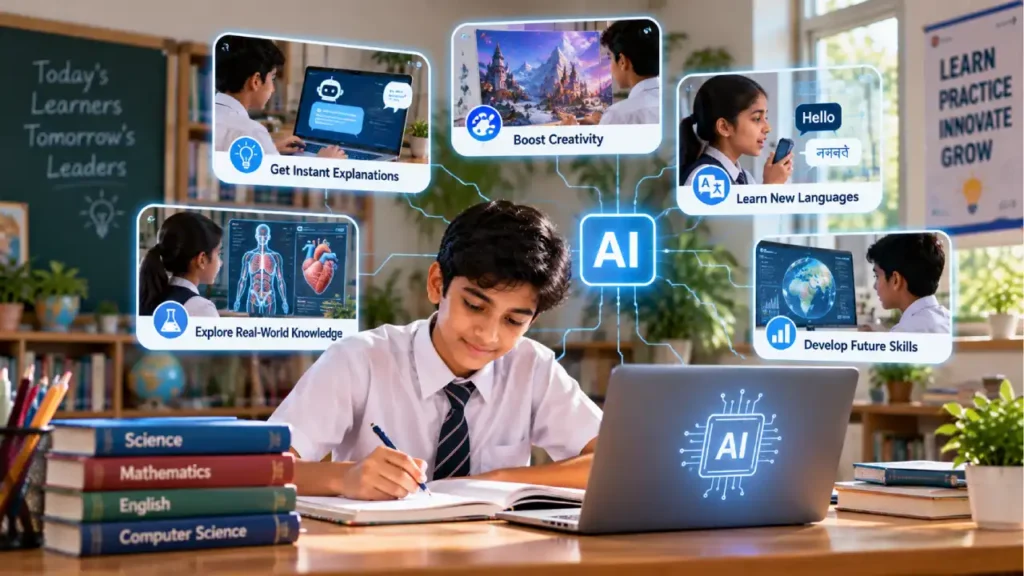
1. Students Can Ask for Different Explanations
Sometimes a student understands a topic after hearing it explained in a different way.
An AI tool can potentially provide another explanation, example or analogy.
For instance, a student struggling with a science concept might ask:
“Explain this concept in simple language and give me a real-life example.”
The purpose should be understanding, not simply getting an answer.
2. AI Can Help With Practice
Students can use AI-assisted tools to generate:
- Practice questions
- Quizzes
- Flashcards
- Revision exercises
- Vocabulary activities
- Topic summaries
For example, instead of asking:
“Give me the answer.”
a student can ask:
“Give me five questions on this topic and let me answer them first.”
That small change makes the technology more useful as a learning aid.
3. AI Can Support Revision
Before an examination, students often need to identify areas they haven’t understood properly.
AI can help generate revision questions or explain concepts that need additional practice.
However, students should still use their textbooks, classroom notes and teacher guidance as important sources of learning.
4. AI Can Help Students Explore Ideas
A student working on a school project may use AI to brainstorm possible topics, questions or approaches.
For example:
“Give me five project ideas about water conservation suitable for a Class 7 student.”
The student can then select an idea and develop it independently.
This is very different from asking AI to produce an entire project and submitting it without understanding the content.
AI Should Not Become a Shortcut for Homework
This is one of the most important conversations parents and teachers need to have.
There is a difference between:
Using AI to understand a difficult topic
and
Using AI to avoid doing the learning yourself.
If a student asks an AI tool to solve every mathematics problem, write every essay and complete every project, the student may finish the task without developing the underlying skill.
The better question is:
“How can AI help me learn this?”
rather than:
“How can AI do this for me?”
That distinction will become increasingly important as AI tools become more capable.
AI for School Students: What Are Some Responsible Uses?
AI can potentially support students in areas such as:
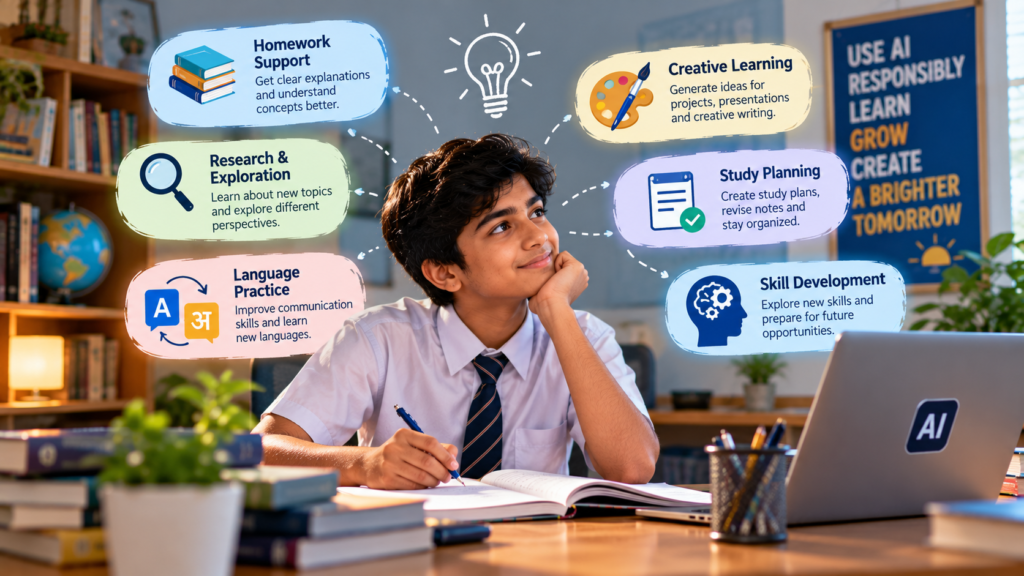
Learning and explanation
Asking for simpler explanations of difficult concepts.
Practice
Generating additional questions for revision.
Brainstorming
Finding possible ideas for projects and presentations.
Language learning
Practising vocabulary, grammar and communication.
Coding
Understanding programming concepts and debugging simple code.
Research preparation
Creating questions that can guide further research.
Creativity
Exploring ideas for stories, presentations, artwork or projects.
The key is to keep the student involved in the thinking process.
Why Students Should Verify AI Answers
One of the biggest lessons of AI education is simple:
AI can be wrong.
An AI system can produce an answer that sounds confident and convincing but contains an error.
This is why students should develop the habit of verification.
For important academic information, students can compare an AI response with:
- School textbooks
- Teacher explanations
- Official educational websites
- Government resources
- Reliable reference materials
A useful habit is:
Ask → Check → Think → Learn
Instead of immediately accepting an AI response, students should pause and ask:
Is this information correct?
Can I verify it?
Does it make sense?
Can I explain it in my own words?
These questions build critical thinking.
AI Safety for Students: What Parents Should Teach
AI safety is not only about cybersecurity.
It also includes privacy, misinformation, responsible use and digital judgement.
1. Don’t Share Sensitive Personal Information
Students should be careful when entering information into online services and AI tools.
They should avoid sharing things such as:
- Passwords
- OTPs
- Financial information
- Private documents
- Personal identification details
- Home addresses
- Private photographs
- Other people’s confidential information
Children should understand that information shared online may not always remain private in the way they expect.
2. Don’t Trust Every AI-Generated Answer
AI can make mistakes.
It can also provide incomplete information or misunderstand a question.
Students should learn that an AI response is something to evaluate, not automatically accept.
3. Be Careful With AI-Generated Images and Videos
Modern AI can generate increasingly realistic photographs, videos and audio.
Students therefore need to understand that:
Something that looks real may not necessarily be real.
Before believing or sharing surprising content, students should consider where it came from and whether reliable sources support it.
4. Respect Other People’s Privacy
Students should not upload someone else’s private photograph, personal details or confidential information into an AI system simply because a tool allows them to do so.
Digital responsibility includes respecting other people’s privacy.
5. Follow School Rules
Different schools may have different rules regarding AI-generated content, homework and examinations.
Students should follow their school’s academic-integrity requirements.
AI should support learning, not become a way around school rules.
What Parents Need to Know About AI in Education
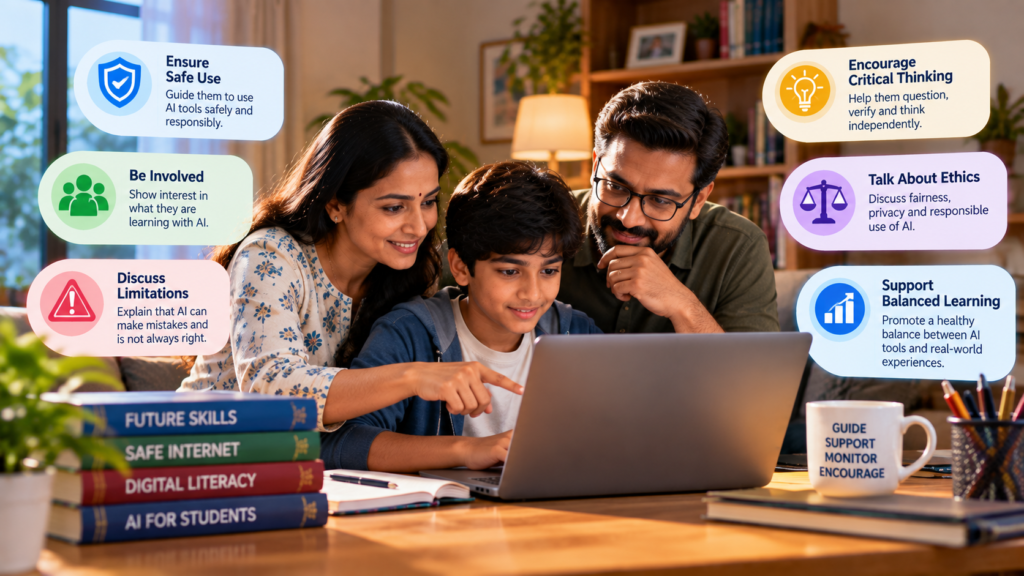
Parents don’t need to become technology experts to help their children.
What matters more is staying involved.
Instead of only asking:
“Did you finish your homework?”
parents can sometimes ask:
“Did you use any AI for this?”
“What did you use it for?”
“How did you check the answer?”
“Can you explain the answer yourself?”
These conversations help children develop responsible habits without turning AI into something mysterious or frightening.
Parents Can Learn Alongside Their Children
AI is changing quickly.
A tool that is popular today may look completely different a year from now.
That means parents do not need to know every new AI application.
Instead, they can focus on a few principles:
Understand. Verify. Protect. Think. Create.
If a child discovers a new AI tool, parents can explore what it does, check its age requirements and privacy considerations, and discuss how it should be used.
This creates a learning environment where technology becomes something the family can discuss openly.
AI Literacy Is More Than Learning AI Tools
There is a temptation to measure AI education by the number of tools a student knows.
But knowing ten AI applications does not necessarily mean a student understands Artificial Intelligence.
A student with strong AI literacy should also be able to recognise:
- When AI is useful
- When AI may be unreliable
- When information needs verification
- When human judgement is required
- When personal information should not be shared
- When using AI would undermine the purpose of an assignment
The technology will continue to change.
The underlying skills will remain useful.
The Role of Teachers in an AI-Enabled Classroom
AI does not remove the importance of teachers.
Teachers understand their students, classroom environment, learning needs and progress in ways that an automated system cannot fully replicate.
AI can assist with certain tasks such as:
- Explanations
- Practice activities
- Brainstorming
- Revision
- Learning resources
Teachers continue to provide:
- Guidance
- Context
- Feedback
- Mentoring
- Classroom interaction
- Encouragement
- Human judgement
The future of education is therefore not simply about AI versus teachers.
It is about finding responsible ways for technology to support teachers and students.
Why Computational Thinking Matters Alongside AI
CBSE’s 2026 framework deliberately combines Computational Thinking and Artificial Intelligence.
That combination matters.
Before students can meaningfully understand many technological systems, they benefit from learning how to break a problem into smaller parts, identify patterns and create step-by-step solutions.
For example, consider a simple everyday problem:
How can we organise a large collection of books?
A student might think about:
- What information do we need?
- How can the books be grouped?
- What patterns can we identify?
- What rules should we follow?
- How can the process be improved?
These are computational-thinking habits.
They can be useful even when the student isn’t writing computer code.
AI, Ethics and Responsible Decision-Making
AI systems can influence decisions and generate content, which creates questions about fairness, privacy and responsibility.
CBSE’s 2026 CT & AI resources specifically mention ethical considerations such as bias and fairness. CBSE Academic
For students, these ideas can be introduced through simple questions:
- Can a computer system make an unfair decision?
- Where does the data come from?
- Could information be incomplete?
- Who is responsible for a decision made with AI?
- Should every problem be solved using technology?
These discussions can help students understand that technology is not only about efficiency.
It is also about responsibility.
AI Literacy and the Future of Indian Students
Students entering school today will grow up in a world where AI is likely to be present in many professions and everyday services.
That does not mean every student needs to pursue a career in Artificial Intelligence.
Instead, AI literacy can become part of a broader set of future-ready skills.
Students can benefit from developing:
- Critical thinking
- Communication
- Problem-solving
- Creativity
- Digital literacy
- Collaboration
- Adaptability
- Ethical decision-making
AI may change the tools people use.
These underlying skills remain valuable.
How Schools Can Support AI Literacy
Schools can introduce AI awareness in age-appropriate ways through:
- Classroom discussions
- Computational-thinking activities
- Project-based learning
- Digital citizenship lessons
- Problem-solving exercises
- Research activities
- Teacher-guided AI demonstrations
- Parent awareness sessions
- Technology-related projects
The objective should not be to make students dependent on AI.
Instead, it should be to help them become confident, thoughtful and responsible users of technology.
Krishnanand Memorial Academy already describes its academic approach as combining classroom learning, practical exposure and reading, with a computer lab and technology-enabled learning environment included among its academic facilities. Krishnanand Memorial Academy
For families exploring the school’s academic environment, you can learn more through the school’s Academics page.
Where Can Students Find CBSE Learning Resources?
Students and parents can also explore official CBSE educational resources rather than relying exclusively on random websites or social-media posts.
The CBSE Academic website provides an E-Books and Supportive Material section with educational materials organised by classes and subjects. CBSE Academic
Official resource:
CBSE E-Books & Supportive Material
The school’s own website also provides direct access to E-Books & Study Material through its Academics navigation. Krishnanand Memorial Academy
A Simple AI Learning Framework for Students
Students can remember five simple steps:
1. Ask
Ask a clear and specific question.
2. Check
Verify important information using reliable sources.
3. Think
Don’t accept an answer simply because it sounds convincing.
4. Learn
Make sure you understand the concept yourself.
5. Create
Use your knowledge to complete the work, project or activity.
This approach keeps the student at the centre of the learning process.
What Parents Should Remember in 2026
Parents don’t need to completely avoid AI.
They also don’t need to give children unrestricted access to every new AI application.
A balanced approach is more practical.
Parents can:
- Learn the basics of AI
- Discuss AI openly with children
- Check age suitability of tools
- Encourage verification
- Protect personal information
- Encourage independent thinking
- Follow school rules
- Talk about responsible digital behaviour
Most importantly, parents can remind children that getting an answer quickly is not the same as learning something well.
Final Thoughts
Artificial Intelligence is changing the educational environment, and Indian schools are beginning to respond to that change in more structured ways.
The introduction of CBSE’s Computational Thinking and Artificial Intelligence curriculum for Classes III–VIII from the 2026–27 session is an important development in this direction. CBSE Academic
But AI literacy is about more than knowing how to use a chatbot.
It is about learning how to question information, solve problems, protect privacy, recognise limitations and make responsible decisions.
For students, the goal should not be to let AI do all the work.
It should be to use technology as a tool while continuing to develop their own knowledge, curiosity, creativity and judgement.
For parents, the goal is not to know every AI tool.
It is to help children build good habits around technology.
And for schools, the opportunity is to prepare students not merely to use AI, but to understand it and engage with it responsibly.
The most useful AI skill a student can develop may ultimately be a very simple one:
Knowing when to ask AI, when to question AI, and when to think for themselves.
Frequently Asked Questions
What is AI literacy for students?
AI literacy is the ability to understand Artificial Intelligence, recognise how AI is used, evaluate AI-generated information and use AI-related technologies safely and responsibly.
What is the CBSE AI curriculum 2026?
CBSE introduced a Computational Thinking and Artificial Intelligence curriculum for Classes III–VIII from the 2026–27 academic session. The framework combines computational thinking with AI concepts and includes areas such as problem-solving, algorithms, data-driven decision-making and ethical considerations. CBSE Academic
Is AI useful for school students?
AI can support learning through explanations, practice, brainstorming, revision, language learning and other activities. Students should use it thoughtfully and verify important information.
How can parents teach AI safety to students?
Parents can teach children not to share sensitive personal information, to verify AI-generated information, respect other people’s privacy, follow school rules and think critically before accepting or sharing AI-generated content.
Can AI replace teachers?
AI can support certain learning activities, but teachers provide human guidance, feedback, context, mentorship and classroom interaction. AI should be treated as a learning support tool rather than a replacement for teachers.
Should students use AI for homework?
Students may use AI as a learning aid where permitted by their school. They should understand the material themselves and follow their school’s rules regarding AI-generated work and academic integrity.
Where can students find official CBSE study materials?
Students and parents can access the official CBSE E-Books and Supportive Material section for educational resources. CBSE Academic